The Association of Cities organised a two‑day Urban Forum in Zagreb titled “Perspectives of Sustainable Cities” with the aim of identifying concrete solutions, good practices and financing models for all cities that wish to plan and implement their programmes sustainably, taking into account the ecological and social dimensions of local development.
The Forum brought together around one hundred participants, representatives of the European Commission, local and regional authorities, development agencies, the Ministry of Regional Development and EU Funds, the Ministry of Environmental Protection and Green Transition, and the Ministry of Physical Planning, Construction and State Assets.
The Forum was opened with welcome remarks by Željko Turk, President of the Association of Cities and Mayor of Zaprešić, and Zrinka Ujević, Head of the Representation of the European Commission in Croatia.
“Cities are the drivers of development in the Republic of Croatia, which is why one of the key topics of this year’s Urban Forum is the new financial perspective, as well as the discussion on green policies that are crucial for the sustainable development of cities. We are aware that Croatia has successfully used the opportunity and withdrawn significant funds from the EU budget envelope for the period 2021-2027, worth a total of 27 billion euros. However, we must also be aware that cohesion and regional‑policy sources, i.e. funds from these instruments, are not unlimited.
Therefore, we must continue to have available financing models for green and sustainable projects that ensure long‑term quality of life for our citizens,” said Željko Turk.
Zrinka Ujević highlighted the following: “The European Commission has already presented a proposal for the new financial framework for the next period, in which cohesion policy will continue to play a key role. Our goal is to bring the European Union even closer to citizens and ensure that funds from the EU budget have the strongest possible impact on local communities and citizens.”
The Forum presented the framework of future European urban policy, with emphasis on key areas such as economy and competitiveness, social well‑being, mobility, environment, climate action, and safety and public protection.
Pia Laurila from the European Commission presented guidelines for the new EU Urban Agenda and the urban dimension of the 2028-2034 financial period, with emphasis on European priorities for sustainable urban development. Marko Peterlin from the Institute for Spatial Policies presented examples of good practice and concrete cases of sustainable urban development from Slovenia, from outdoor community projects in Ljubljana to the revitalisation of the old town centre with artists in Celje. Lucija Jusup from the Association of Cities presented current opportunities for cities within the URBACT programme and the European Urban Initiative, followed by a moderated discussion in which Nataša Mirić from the Dubrovnik Development Agency and Marko Ercegović from the Association of Cities discussed the integrated approach to sustainable urban development, with emphasis on URBACT projects implemented so far.
Zrinka Šajn from the European Urban Initiative presented innovative financing models for cities, and Senka Jurković from the Croatian Bank for Reconstruction and Development presented the first results of the Urban Development Fund. A total of 172 million euros has been secured for loan placement to users, of which 50% is financed through the European Regional Development Fund and 50% through HBOR. So far, 24.4 million euros have been approved for six projects: construction of a sports centre, construction of a business building, the Integration Centre, renovation of a holiday facility, and reconstruction of a Cultural Centre and an Interpretation Centre. Alen Prelec, Mayor of Brdovec, presented an example of a project financed through the Urban Development Fund.
Elena Kostadinova from the European Commission presented innovative financing models for projects aimed at achieving climate neutrality in cities. Slađana Ćosić presented the support of the European Investment Bank to cities, and the day concluded with a workshop led by Natalija Šimunović from the Ministry of Regional Development and EU Funds on EU horizontal principles in infrastructure investments.
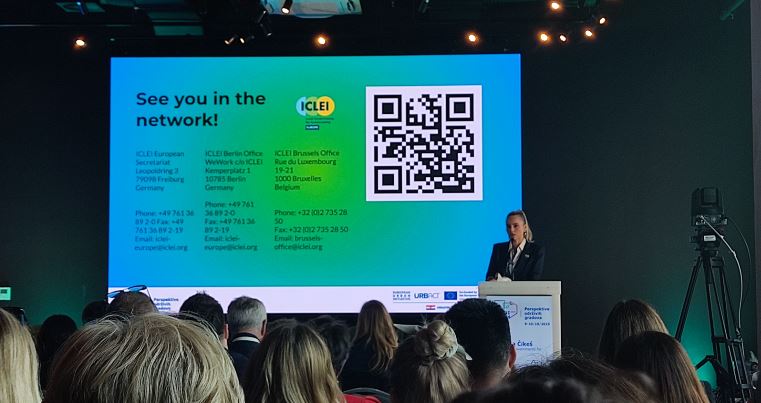
The second day of the Forum began with a presentation by Nina Mia Čikeš on opportunities for European and global networking for local sustainability, with special emphasis on ICLEI activities.
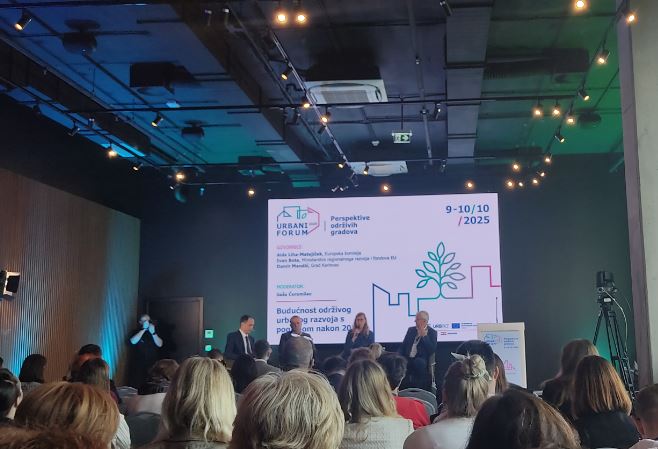
This was followed by a panel discussion on the future of urban development and perspectives within the next EU budget period, with participants Aida Liha‑Matejiček, Head of the Croatia and Romania Unit at the European Commission, Ivan Bota, Director of the Directorate for Regional Development at the Ministry of Regional Development and EU Funds, and Damir Mandić, Mayor of Karlovac. The panel highlighted that urban development is much more than spatial planning, and the key question is how cities today will respond to the many climate, digital, social, economic and security challenges. Urban development is important because cities are the economic engines of the European Union, generating 85% of GDP and 75% of employment.
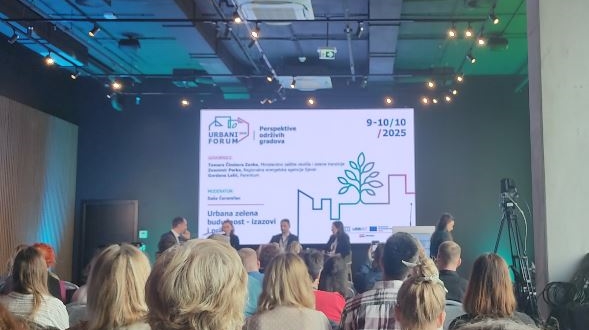
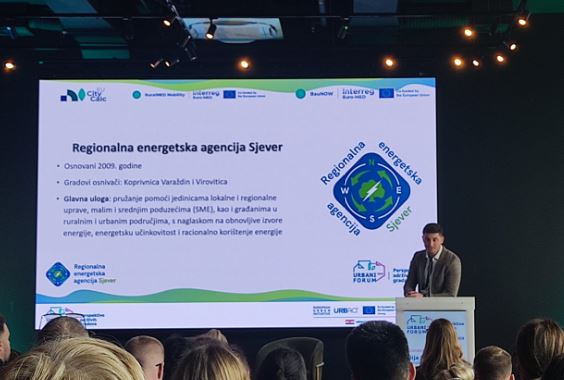
Tamara Čimbora Zovko from the Ministry of Environmental Protection and Green Transition presented the Nature Restoration Regulation and what it means for cities, while Ilija Beljan from the North Regional Energy Agency spoke about strengthening city capacities for the green transition. A panel discussion followed, in which views on the green urban future were presented by Tamara Čimbora Zovko from the Ministry of Environmental Protection and Green Transition, Tomislav Perko from the North Regional Energy Agency, and Gordana Lalić from the Poreč city company Parentium. The future is undoubtedly green, and synergy between policy and expertise is essential for achieving optimal results.
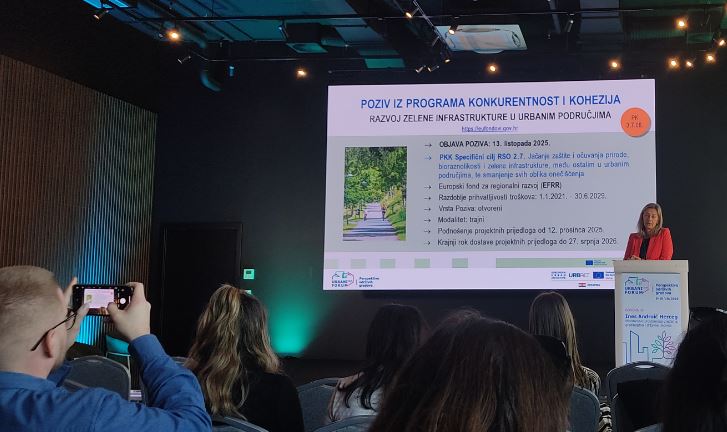
Ines Androić Herceg from the Ministry of Physical Planning, Construction and State Assets presented the call “Development of Green Infrastructure in Urban Areas”, worth 71 million euros. The call will be published in October and is intended for local and regional authorities with the aim of climate‑change adaptation and strengthening resilience to risks through the integration of nature‑based solutions. The minimum project amount is 200,000 euros, and the maximum can reach 4,500,000 euros.
The ActGREEN project also participated in the Urban Forum, represented by colleagues Lidija Pavić Rogošić/ODRAZ, Natalia Halbauer/City of Zagreb and Nebojša Ivančević/City of Zagreb, with the support of Dražana Halar/City of Zagreb. At the conference, we had the opportunity to meet and initiate cooperation with Ilija Beljan/REA North and Boris Iharoš. We also had the opportunity to hear updates from the Ministry of Physical Planning on green infrastructure, green urban renewal and other topics related to the implementation of the European Green Deal.
Source:
Association of Cities