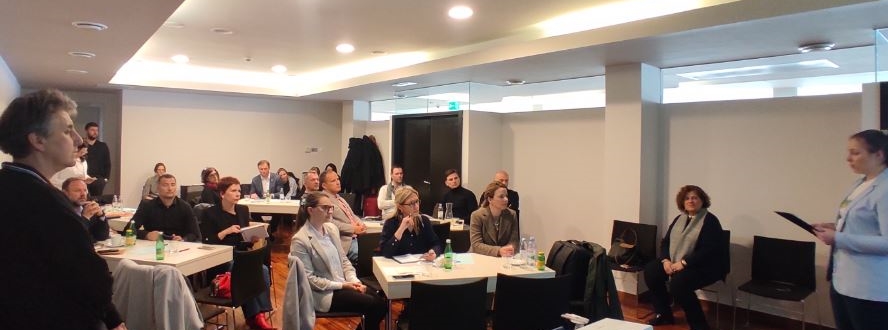
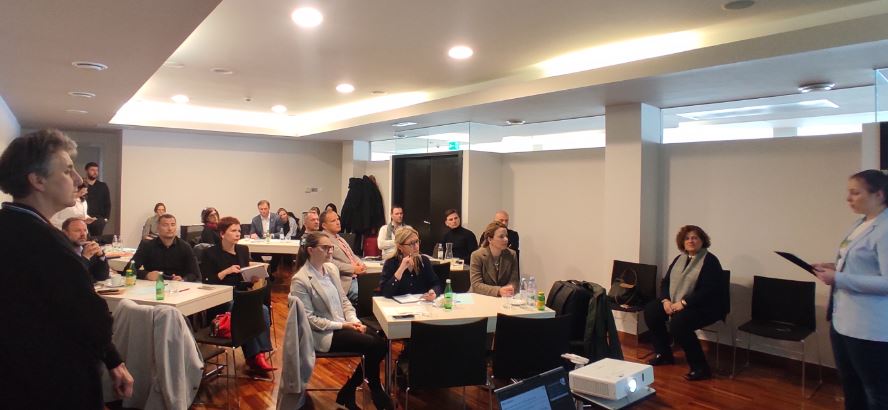
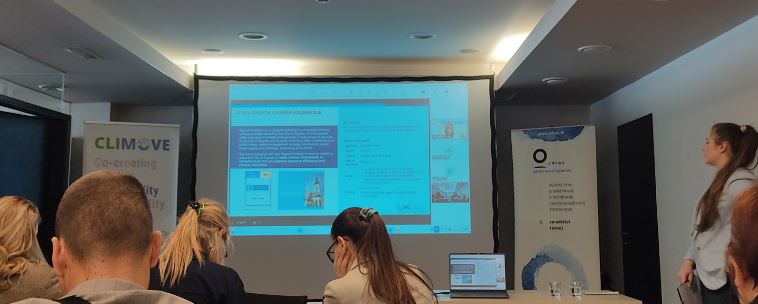
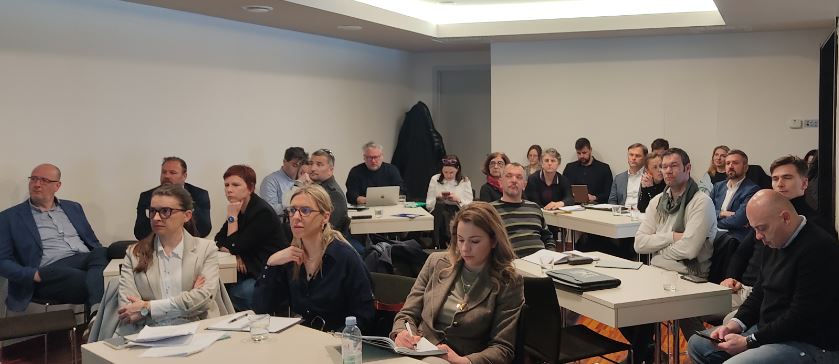
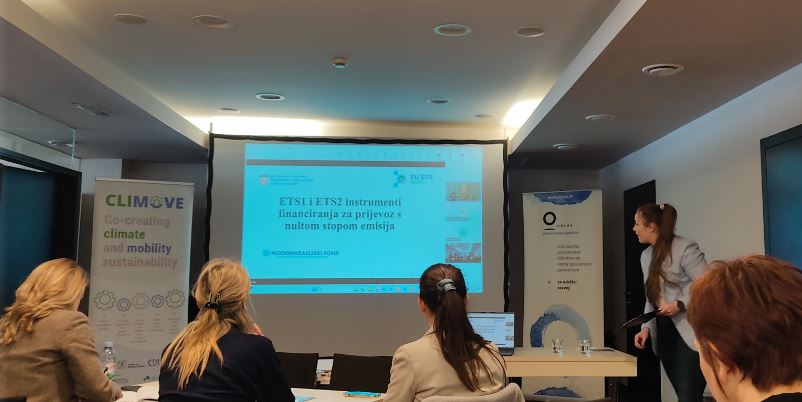
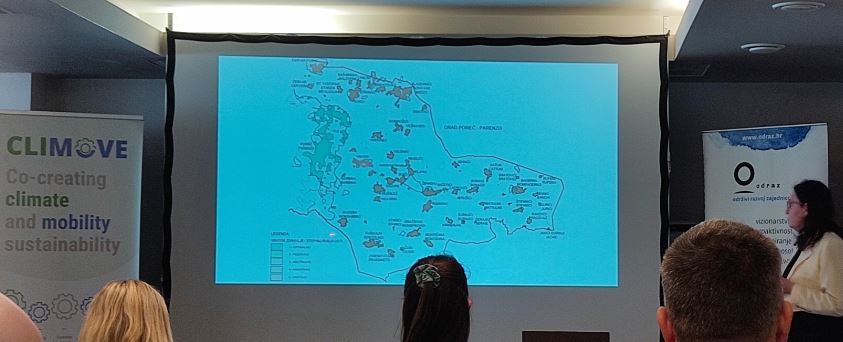
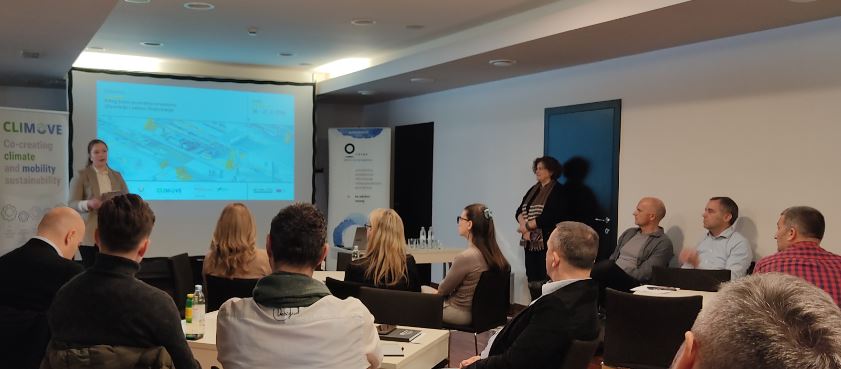
A workshop on integrated spatial-transport planning and green financing was held in Poreč from 26 to 27 March 2026, organised by ODRAZ in cooperation with the City of Poreč and Net Zero Cities. The workshop gathered more than 40 participants, including representatives of ministries, cities, public‑transport operators, the civil sector and experts working on climate neutrality and EU programmes.
The aim of the workshop was to encourage a shift in planning approaches — from sectoral and reactive to integrated and systematic spatial action — and to explore innovative ways of financing measures and projects that contribute to climate neutrality.
Through experience sharing and practical work, the workshop aimed to demonstrate how connecting spatial and transport planning, while considering climate and social goals, can lead to higher‑quality and more resilient solutions for cities and institutions in Croatia.
The integrated approach to spatial-transport planning is based on the understanding that the way we plan space directly shapes mobility needs, making it essential to connect space, transport, health and climate objectives. Climate resilience is not only a long‑term ambition but something that must be systematically planned and built today through concrete spatial decisions.
Green financing and budgeting enable the implementation of such solutions by aligning budgets with climate goals and using available funding sources, which is particularly important in the context of the new EU financial framework.
The first day began with a presentation of the CLIMove project and the work programme (Magdalena Makar, ODRAZ), emphasising the need for an integrated planning approach in the context of climate change and challenges such as the loss of interdisciplinarity and the dominance of cars in planning.
Aljaž Plevnik and Luka Mladenovič (Urban Planning Institute of the Republic of Slovenia, Transformative Transport Planning Group) presented the concept of integrated transport-spatial planning, focusing on accessibility and the influence of space on mobility patterns. Nataša Basanić Čuš (City of Poreč) presented a long‑standing example of healthy urban planning and citizen involvement, while Gordana Lalić (Parentium d.o.o., European Climate Pact) spoke about the challenges of seasonality and the transformative framework for achieving climate resilience in Poreč.
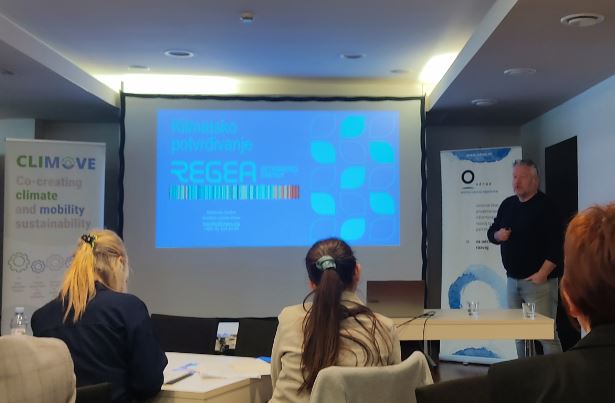
Miljenko Sedlar (REGEA) presented the INPLAN project methodology for integrating climate goals into planning and budgeting, highlighting climate proofing and the importance of climate contracts for cities. Hana Zoričić and Nikolina Bibić (Ministry of Finance) presented the methodology for green budget tagging as a tool for linking public finances with environmental objectives.
The workshop continued with interactive group work on a concrete example — selecting and planning the location of a retirement home in Poreč, led by Aljaž Plevnik and Luka Mladenovič (UIRS). Participants first analysed three potential locations and assessed their suitability based on accessibility to services and transport connections.
In the second part of the workshop, participants assumed the roles of different stakeholders (residents, visitors, employees, neighbours) and defined their needs, daily mobility patterns and obstacles. Based on this, concrete measures were proposed for the planning and construction phases, as well as long‑term spatial solutions.
The second day of the workshop focused on the financial framework for achieving climate neutrality, with emphasis on available funding sources and their application at the local level.
Introductory presentations covered key financial instruments and opportunities for the climate transition.
Ana Juras (Ministry of Environmental Protection and Green Transition) presented financing opportunities through the ETS system, the Modernisation Fund and the Social Climate Fund, with emphasis on sustainable transport and energy transition.
Milica Sredanović (International Finance Corporation) presented opportunities for green and blue financing of local projects through development finance institutions.
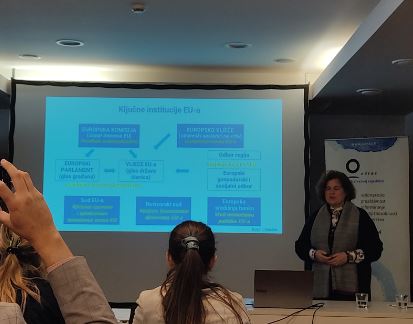
Lidija Pavić‑Rogošić (European Economic and Social Committee) presented the proposal for the new EU Multiannual Financial Framework and its implications at the local level.
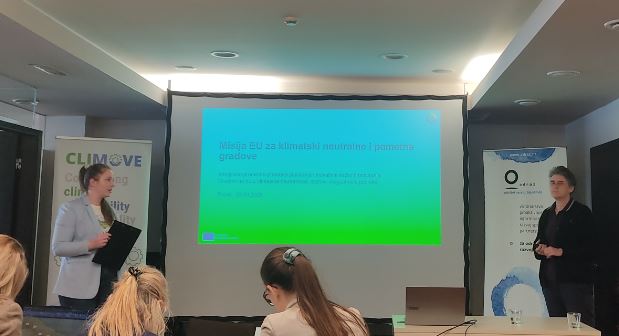
Vlatka Berlan Vlahek (Energy Cities, NZC consortium) spoke about the EU Mission for Climate‑Neutral Cities and available support for cities, while Miljenko Sedlar (REGEA) discussed climate proofing as a key tool for planning more resilient and cost‑effective long‑term projects.
In the second part of the day, examples of good practice from Mission Cities were presented.
Tomaž Lanišek (City of Kranj) highlighted the importance of political will and innovative approaches in financing city projects.
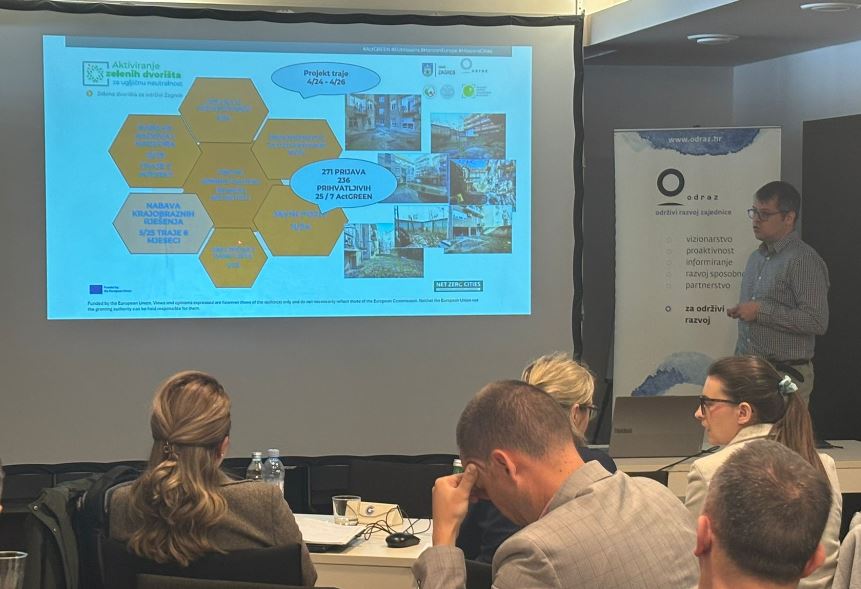
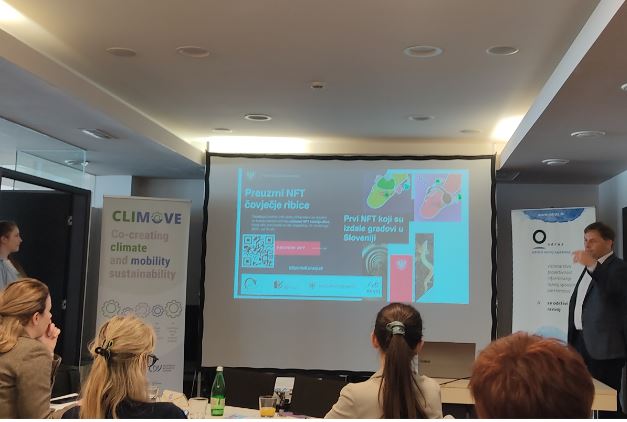
Nebojša Ivančević (City of Zagreb) presented the
ActGREEN project, which involves citizens in greening private courtyards using nature‑based solutions; participants were informed about the project’s financial‑sustainability elements and the benefits of cooperation with the NetZeroCities programme.
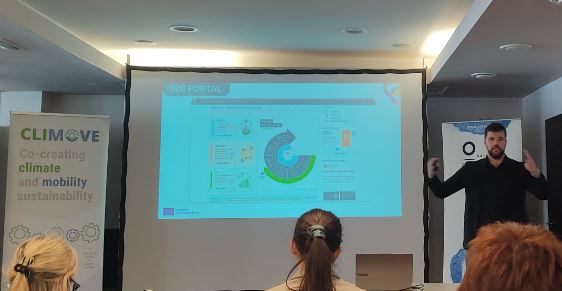
Luka Vidan (ODRAZ) presented the Net Zero Cities portal as a tool for planning, progress monitoring and knowledge exchange among cities.
The two‑day stay in Poreč concluded with a workshop led by Vlatka Berlan Vlahek (Energy Cities, NZC consortium) on innovative financing models for climate‑neutrality projects. Participants analysed different funding sources and developed proposals for possible financing approaches in the local context, focusing on projects supporting the goal of climate‑neutral cities.
It was emphasised that traditional financing models are insufficient to close the financial gap of the green transition and that a shift towards combined and innovative approaches is necessary. Cities must act as catalysts connecting public, private and civic funding sources, using instruments such as green bonds, ESCO models, participatory budgeting and blended finance. A key direction highlighted was combining different sources and strengthening local capacities to bridge the financial gap and enable long‑term, sustainable implementation of the climate transition.
The discussion opened a range of practical challenges — from the need for stronger cooperation between the public and private sectors to the necessity of simplifying procedures and improving access to funds, especially for smaller cities. It was stressed that without political will and understanding of the benefits of investment (e.g., in cycling infrastructure instead of parking lots), real change cannot occur, nor without incorporating local needs and bottom‑up approaches in planning. Innovative financial models, citizen participation and continuous education were also highlighted as essential elements for enabling systemic change.
The ActGREEN project thanks its project partners from ODRAZ for the invitation and support in organising the visit to the CLIMove workshop, as well as for synergistic activities within the umbrella of the NetZeroCities programme and consortium.
For the ActGREEN project, this was an opportunity to strengthen cooperation with other future members of the NetZeroCities consortium supporting the activities of EU Mission Cities. Through our example and the benefits of collaboration, we encouraged other participating cities — such as Poreč, Šibenik, Omiš, Labin, Varaždin, Križevci and others in Croatia — to join the NZC initiative for mission‑minded cities. Events within the NZC programme foster a high level of cooperation among Mission Cities and cities promoting the EU Green Deal and UN sustainability goals in the fight against and adaptation to climate change.
Source:
ODRAZ