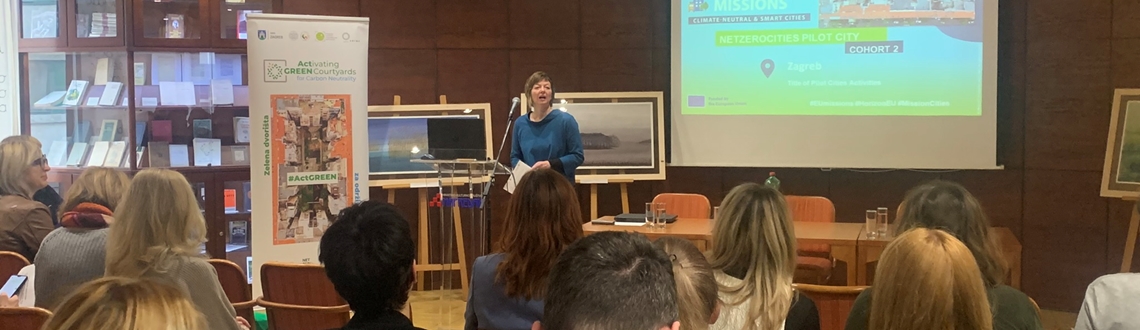
The educational event
“Path Toward a Sustainable and Green City”, held on 25 February 2025 in Zagreb, brought together more than 70 participants. Among them were experts, representatives of institutions, associations, and citizens interested in raising awareness about the importance of green spaces and sustainable solutions in urban environments. The education covered key topics such as the development and maintenance of green infrastructure, nature‑based solutions, and the impact of these solutions on quality of life, with a special emphasis on climate change adaptation.
The event was led by Iva Rechner Dika from the University of Zagreb, Faculty of Agriculture (Department of Ornamental Plants, Landscape Architecture and Garden Art, Division of Horticulture and Landscape Architecture). In her opening speech, she highlighted the crucial role of nature in creating sustainable cities and the importance of applying green solutions in urban environments.
The first presentation was delivered by
Irena Matković from the City of Zagreb, who presented the
City’s green policies, emphasizing their importance for Zagreb’s future development, with a particular focus on expanding green areas and introducing sustainable solutions that contribute to quality of life in urban spaces. The City of Zagreb is implementing several initiatives, including a greening program with a planned planting of 8,000 trees annually and the project “Activation of Green Courtyards for Carbon Neutrality”, funded through the EU Horizon Europe programme. Special attention is also given to preserving existing green infrastructure such as Medvednica, Maksimir, and the Green Horseshoe, as well as amendments to the Spatial Plan to increase green zones.
This was followed by expert lectures from professors of the University of Zagreb, Faculty of Agriculture.
Ines Hrdalo spoke about
green infrastructure and its importance in creating sustainable and resilient cities, highlighting its role in reducing greenhouse gas emissions and adapting to climate change. She also emphasized the importance of public participation in planning to foster greater awareness and empathy toward the “green” values of space.
Iva Rechner Dika presented nature‑based solutions and explained the fundamental concepts behind them. She noted that nature‑based solutions use ecosystems as infrastructure to provide or enhance natural services that benefit society and the environment. Their implementation requires cooperation across sectors and an interdisciplinary approach in all project phases. Successful implementation includes a holistic approach and the development of long‑term strategies that optimize needs and sustainable development. Involvement and cooperation with residents are essential for long‑term success.
Jana Kiralj Lacković delivered a lecture titled
“Choosing a Room with a View: How Being in and Near Nature Affects Our Well‑Being”, highlighting the significant impact of natural environments on human well‑being, mental health, and social connectedness, especially in urban settings, offering valuable insights from ecological psychology.
Miroslav Poje explained
the importance of plant maintenance in urban environments through proper site inventory, selection of native species, and a sustainable approach that reduces the need for intensive maintenance. He emphasized that green spaces are of higher quality when residents themselves use and care for them, supported by local authorities through education and resources such as rainwater tanks and composters. Regular maintenance is not only aesthetic but essential for community health, the environment, the economy, and safety.
In his presentation,
Dario Kremer highlighted that
urban dendroflora — trees, shrubs, and climbers — plays an important ecological, aesthetic, and structural role in urban environments, contributing to CO₂ reduction, oxygen production, temperature and noise regulation, and improved quality of life. Planting native species is recommended due to easier maintenance and biodiversity support, while invasive species such as tree of heaven and black locust should be avoided due to their negative ecological impact.
After the set of lectures by professors from the Faculty of Agriculture,
Katarina Burazin from the consulting company Vita projekt d.o.o. presented the City of Zagreb’s
pilot project “Green Courtyards.” In partnership with residents, the project aims to green residential courtyards to improve quality of life, reduce the effects of climate change, and increase biodiversity. The project is being implemented at seven pilot locations in densely built areas of the city, including Donji Grad, Medveščak, Črnomerec, Maksimir, and Trešnjevka.
In addition to theoretical lectures, participants had the opportunity to explore practical solutions for greening urban environments. Examples of good practice from other cities served as inspiration for implementing similar solutions in Zagreb and other Croatian cities.
Mateja Petronijević from the City of Pula presented
current projects aimed at creating a greener and more sustainable urban space. Pula is implementing a series of green projects such as urban gardens, rain gardens, greening of parking areas and public spaces, and installation of public drinking fountains, all aimed at sustainable development and climate adaptation. Funded through EU and national sources, these projects contribute to increasing green areas, energy efficiency, and quality of life.
Darja Matjašec and Filipa Valenčić from the Department of Landscape Architecture at the Biotechnical Faculty of the University of Ljubljana shared examples of good greening practices in Ljubljana. Slovenia is implementing numerous urban greening projects through the INTERREG ZeleNatura initiative, focusing on green infrastructure, urban gardens, rain gardens, and sustainable public spaces to improve quality of life and climate resilience.
This event was an excellent opportunity to exchange experiences and ideas on implementing green infrastructure and sustainable urban solutions. The education was only the first in a series of events planned for 2025. The ActGREEN project team plans to organize additional educational activities, and all interested parties can follow announcements and participate in future events on the official project website.
Thank you all for participating! We look forward to future educational events and to jointly creating a sustainable and green Zagreb.